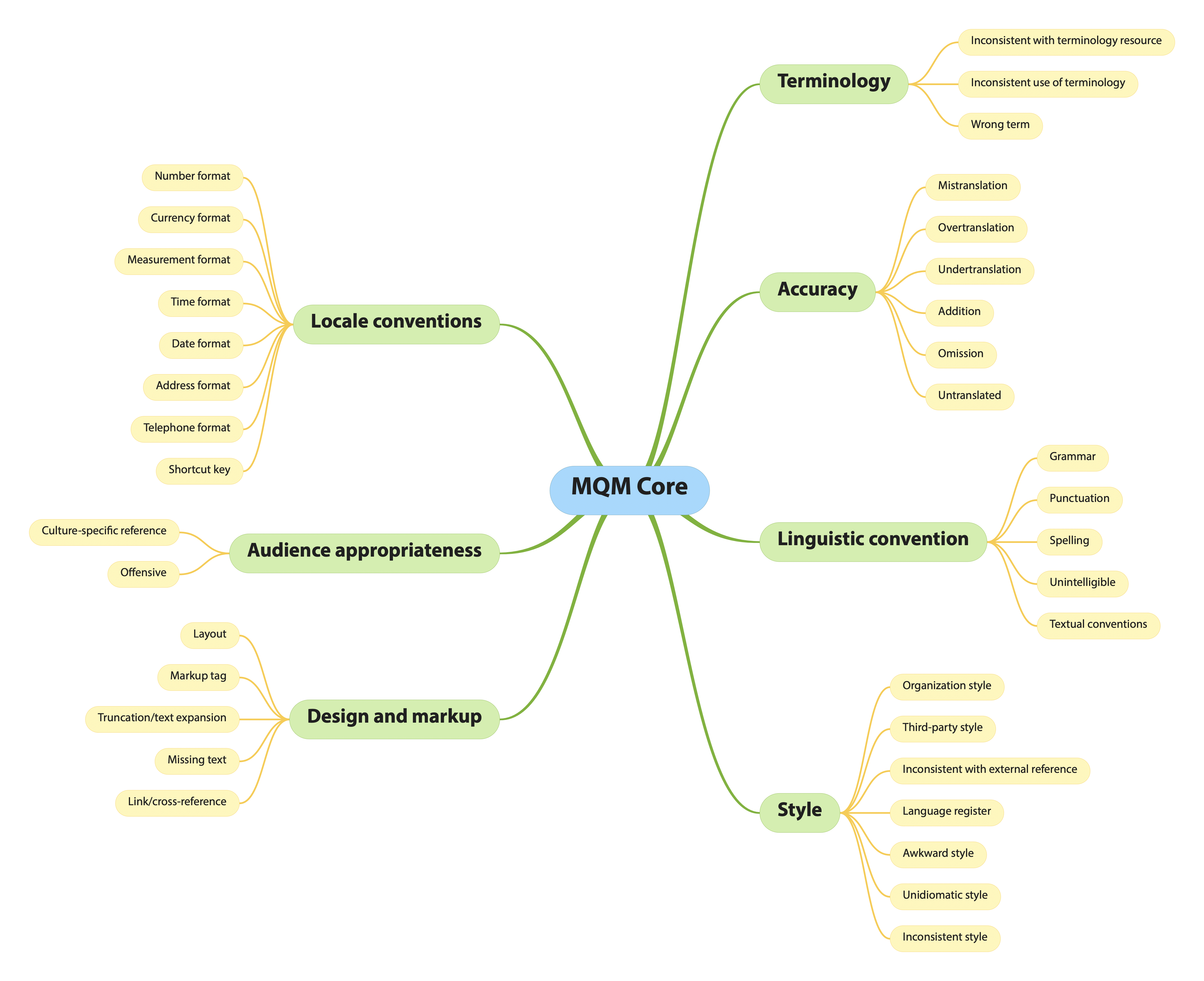
Multidimensional Quality Metrics (MQM) has its roots in the work I did on the unreleased LISA QA Model 4.0. After I was approached by Hans Uszkoreit to continue working on a shared framework for evaluating human and machine translation, I moved to Berlin and began work on what became MQM as part of first the QTLaunchPad and then QT21 projects.
MQM started by comparing all then-existing publicly declared quality evaluation frameworks to find their common elements and differences. From there, I and my team created a master vocabulary and definitions that allowed us to declare all frameworks in a shared conceptual space and network of hierarchically linked error types (now called MQM Full). The key innovation was the ability to subset the master list of error types and represent it as differing degrees of granularity to meet specifications-driven quality requirements.
In addition, we introduced the Verity dimension (later renamed Audience appropriateness), a categorical approach for dealing with the need to adapt translations for different audiences that was entirely missing in then-current quality approaches. For example, if a manual written in English refers to a ground wire as “bare copper,” a correct translation into German as “bare Kupfer” would actually be incorrect because ground wires in Germany are sheathed in green and yellow insulation. The error types we developed to hand such issues were a genuinely new intellectual contribution in the field of translation quality evaluation. Although these issues were well known in translation theory, they had not previously been applied to systematic evaluation.
In 2014, it became apparent that MQM had to be unified with the TAUS Dynamic Quality Framework (DQF), which was then emerging as a shared way to exchange quality information. Over an intense period of collaboration in 2014 and 2015, both MQM and DQF changed, with DQF becoming a fully-compliant subset of MQM. The DQF subset found widespread industry adoption, but has now been replaced by MQM Core.
Since 2015, MQM has been managed by the MQM Council, which started as an informal management group, but which has evolved into a corporation with the mandate of promoting and furthering the development of MQM.